
Industrial Clusters
AGII aims to identify, shepherd, and support African green industrialisation opportunities, going beyond individual projects to drive continent-wide economic transformation.
AGII is pan-African and Africa-centric. It operates strategically at a pan-African level, with operations in individual countries that demonstrate a range of specific pathways to industrialisation.

Africa can, and should, accelerate green industrialisation for the benefit of Africa and of the world
Africa has the power, people and resources to drive decarbonisation of global industry and manufacturing, providing an invaluable service to the world, and driving economic development on the continent. The African Union recognised this potential in the Nairobi Declaration, which commits to realising Climate Positive Growth (CPG) for Africans, and all global citizens. Green industrialisation will unlock green businesses and sectors across Africa, driving Africa’s green unicorns and decacorns, creating supply chain opportunities and significant job creation across the continent. All these activities taken together will drive economic growth, and boost regional and intercontinental trade.
Now is the time: continental and international factors enable Africa to drive a different trajectory to those of past dashes for African resources
First, Africa’s resources themselves are of a far higher quality and concentration than can be found anywhere else in the world in terms of minerals grades and power. Second, the geopolitical focus on creating supply chain diversification and independence drives established industrial actors to consider a range of partners, creating opportunities for Africa. Third, climate leadership from African leaders and the global south more broadly is gaining international recognition, with AU G20 membership, and Brazil hosting COP30. Fourth, existing regional integration efforts, led by AfCFTA and regional power pools give markets necessary scale to drive cost competitiveness. Fifth, new high-margin demand for power, from cloud computing giants and others, can change the economics of power production and offtake.
We must collaborate to shape and drive Africa’s industrial competitiveness
A prosperous drive towards green industrial growth in Africa is not inevitable. On one hand, past trajectory has seen Africa lose out. African countries (particularly in sub-Saharan Africa, excluding South Africa) have very low industrialisation rates. For example, value addition to metal ores are often <10% of raw ores exported. Since 1990, industry and manufacturing have seen shrinking shares of employment. Countries import close to 100% of critical inputs such as fertiliser, which exposes economies to dollar driven fluctuations in prices, exacerbating tight fiscal positions.
On the other hand, African countries need each other in regional and continental collaboration to capitalise on our inherent competitiveness
For many value chains, the components are spread across countries, mineral deposits in one country, transport and trade links in another. The Lobito Corridor demonstrates hard infrastructure integration, whereas the Tripartite Cooperation on climate change mitigation between EAC, SADC, and COMESA was a model of soft infrastructure integration. This collaboration sets the conditions so that all countries within the continent are not all trying to trade the same goods, at the same level of value addition but instead collaboration will drive specialisation, which will fuel continental competitive advantage, as described by WTO chief Dr Ngozi Okonjo-Iweala.
Focus Areas
Africa has 40% of the world’s renewable energy potential, 40% of the world’s critical minerals and (by 2030) 40% of the world’s young people. This is key to delivering the global energy transition. To capture the resources and power required there will be huge development and investment.
However, each country within the continent has unique ‘climate competitive’ advantages – those new industries and sectors where it can be uniquely well positioned, based on its own dividend, ability to attract capital, deliver on capital projects etc. At the same time, Africa’s natural resources, ecology and biodiversity currently provides essential adaptation management services to the world (mostly without charge).
In preparation of the AGII, the following sectors have been identified as likely to be focus for the first clusters.
AGII focuses on sectors and industries where Africa has the potential to have financially viable ‘climate competitiveness’. Some of the early sectors include the following:

Renewable energy power generation, transmission, balancing and storage
Africa’s climate competitiveness in many sectors, depends on cheap, renewable power. Reducing the cost and enhancing the reliability of power will be key goals, alongside driving increased generation capacity.
A mix of balancing for variable renewables, integrating different generation technology through power pools, storage, and establishing supportive policies and regulations, will all be required. This approach will realise the full potential of the continent’s rich renewable energy resources, to power green industry at scale. By integrating these elements, Africa can create a robust framework for affordable and reliable energy, improving economic development and environmental sustainability.

Value addition to minerals and metals, building on responsible mining
Africa has 40% the minerals critical for technology and the energy transition. The continent’s deposits of essential minerals such as copper, cobalt, lithium, and rare earth elements are in higher concentrations than other locations globally, offering competitive returns, and a strategic position for the continent.
Current minerals and metals processing efforts are inconsistently distributed and fall far short of the total volume of ore extracted annually – for both specific transition minerals mentioned above and existing mineral commodities such as bauxite and iron ore.
Processing more of these minerals within Africa can increase the value of exports and can drive a shift towards sustainable economic development, through diversified and increased employment, and economic resilience.

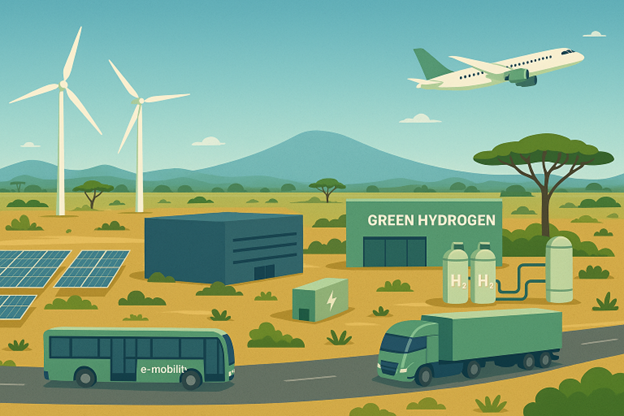
Green hydrogen production and its downstream products, including green ammonia for fertiliser
Locally produced substitutes for (chemical) fertiliser import include biochar blends, organic fertiliser, and locally produced chemical fertiliser from green ammonia. The latter holds significant promise for reducing Africa’s dependency on imported fertilisers, which is ~ 11.5 million tonnes annually.
With the continent’s fertiliser usage markedly below the global average—17kg per hectare in Africa compared to 135kg per hectare globally—and up to 90% of Sub-Saharan Africa’s fertiliser being imported, the potential for local production driven by the continent’s abundant renewable energy resources is vast.

Sustainable synthetic fuels, including for shipping and aviation
The global shipping industry drives 3% of annual GHG emissions and is shifting to decarbonisation through incentives and mandates, such as the International Maritime Organisation’s new GHG strategy and the extension of the EU’s Emissions Trading Scheme to include shipping.
Africa can serve the market for low and zero-carbon maritime fuel bunkering, particularly methanol and ammonia (hydrogen derivatives). ~ 15% of global green hydrogen demand is expected to be from the shipping sector by 2050. Maritime fuel can be an initial off-taker for green hydrogen production capacity. A similar movement emerges in sustainable aviation fuel (SAF), kickstarted by regulation: a small but growing SAF blending for flights originating from the EU.
The open discussion on whether book-and-claim will be permissible to meet this obligation, will have an immediate impact on Africa’s potential to meet growing demand under this mandate, setting a potential priority for the Africa – Europe policy dialogue.
Climate Sherpas, Shipping leaders, and green hydrogen producers agree on ambitious uptake targets for 2030 to enable a net-zero maritime sector. In 2023, beginning in 2025, fuel uplift at EU airports must contain at least 2% SAF. That percentage will increase gradually each year, with mandates including 6% by 2030, 20% by 2035, and eventually 70% by 2050. These requirements will apply to all flights originating in the EU, regardless of destination.

Cement production and other building materials (including bio-based materials)
Africa’s population is set to double by 2050 and 80% of necessary buildings are yet to be constructed – and already, Africa is a net importer of many building materials. This creates an opportunity to expand and localise production to meet domestic demand – which can be done green-from-the-start if the business case makes sense. This includes the processing of Africa-mined commodity minerals such as iron ore and bauxite, low-emission cement, and novel bio-based building materials such as Cross-Laminated Timber (CLT) and bamboo-based materials. Bio-based materials can reduce the GHG footprint of the built environment, capture atmospheric carbon, and generate local jobs and financial incentives for sustainable forest management and nature conservation.